Cycle Syncing 101: A Gentle Guide to the Four Phases of Your Cycle
What cycle syncing is, what each phase of your menstrual cycle feels like, and simple ways to support your body through the month—without rigid rules.
For education, not medical advice. This article shares general wellness information and isn't a substitute for care from your doctor. Talk with a qualified healthcare provider before making changes to your diet, exercise, or supplements. Full disclaimer
In short
What cycle syncing is, what each phase of your menstrual cycle feels like, and simple ways to support your body through the month—without rigid rules.
If you've ever noticed that you feel unstoppable one week and want to hide under a blanket the next, you're not imagining it. Your hormones rise and fall in a fairly regular pattern across the month, and for many women those shifts can influence your energy, appetite, sleep, and mood.
Cycle syncing is simply the practice of noticing those patterns and adjusting your food, movement, and schedule to work with them. It isn't a diet or a strict protocol—it's a way of listening to your body with a little more context.
A quick note on the science
Research on hormone fluctuations across the cycle is well established. Research on cycle syncing as a lifestyle method is still emerging. Think of it as a helpful framework for self-awareness, not a guaranteed fix.
What's actually happening in your body
Two main hormones lead the monthly rhythm: estrogen and progesterone. Two others from the brain—follicle-stimulating hormone (FSH) and luteinizing hormone (LH)—act as messengers that tell your ovaries when to mature an egg and when to release it.
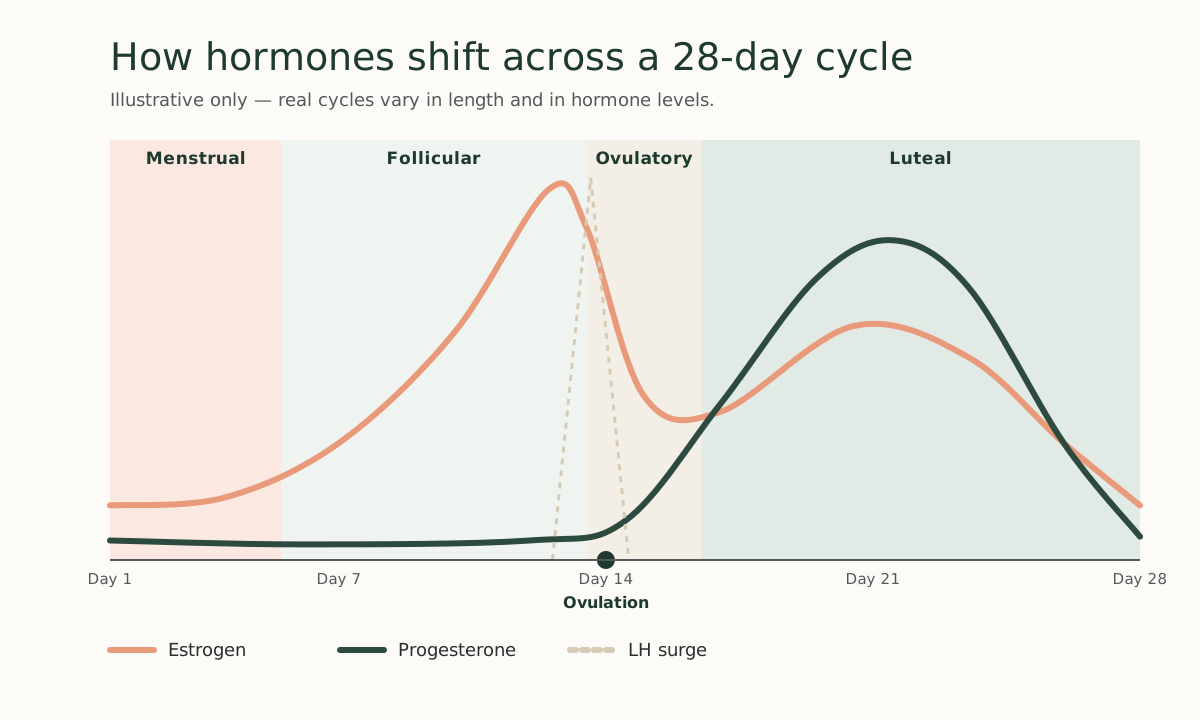
In short: many women find that the estrogen-rising days feel more energizing and outward-facing, while the progesterone days feel calmer and more inward. When both drop just before your period, some notice lower mood or energy. Everyone is different, though—some women notice very little change, and that's normal too.
The four phases at a glance
A "textbook" cycle is 28 days, but anything from about 21 to 35 days is common in adults. Your phases will stretch or shrink to match your own rhythm—the follicular phase is usually the one that varies most.
| Phase | Typical days | Hormones | How you may feel |
|---|---|---|---|
| Menstrual | 1–5 | Estrogen and progesterone low | Tired, inward, wanting rest |
| Follicular | 6–13 | Estrogen rising | Energized, creative, optimistic |
| Ovulatory | 14–16 | Estrogen peaks, LH surges | Social, confident, strong |
| Luteal | 17–28 | Progesterone rises, then both fall | Calmer, then possibly PMS |
1. Menstrual phase (roughly days 1–5)
Estrogen and progesterone are at their lowest. Many women feel more tired and inward-focused.
- Food: warm, comforting meals; iron-rich foods like lentils, leafy greens, and lean red meat or tofu to help replace what's lost in bleeding. Pair them with vitamin C (citrus, bell peppers) to boost iron absorption.
- Movement: gentle walks, stretching, and restorative yoga if you feel low on energy (see exercise during your period).
- Life: protect your calendar where you can. Rest is productive.
2. Follicular phase (roughly days 6–13)
Estrogen climbs as your body prepares to ovulate. Energy, optimism, and motivation often rise with it.
- Food: fresh, vibrant meals with plenty of vegetables, whole grains, and protein.
- Movement: a great time to try something new or build up intensity.
- Life: brainstorm, plan, and start projects.
3. Ovulatory phase (roughly days 14–16)
Estrogen peaks and a surge of luteinizing hormone triggers ovulation. Many women feel their most social and confident.
- Food: fiber-rich produce and balanced plates to keep you fueled.
- Movement: some women find higher-intensity workouts feel easiest now—if that's you, enjoy it.
- Life: schedule the presentation, the hard conversation, or the date night.
4. Luteal phase (roughly days 17–28)
Progesterone rises, then both hormones fall if pregnancy doesn't occur. In the days before your period you may notice cravings, bloating, or mood changes.
- Food: regular, satisfying meals with complex carbohydrates and protein can help steady energy and cravings. (Here's our full guide to eating in your luteal phase.)
- Movement: strength work and moderate cardio early on; gentler sessions as your period approaches.
- Life: finish projects, tidy loose ends, and plan extra downtime.
A sample cycle-synced week
Here's what a realistic week might look like in your follicular phase—no special ingredients, no two-hour workouts.
| Day | Movement | Meal idea |
|---|---|---|
| Monday | 30-minute brisk walk | Veggie omelet with whole-grain toast |
| Tuesday | Full-body strength (30 min) | Chicken or tofu grain bowl with greens |
| Wednesday | Dance or cycling class | Salmon, quinoa, and roasted vegetables |
| Thursday | Rest or gentle yoga | Lentil soup with a big side salad |
| Friday | Strength + short intervals | Turkey or bean tacos with slaw |
| Weekend | Hike or long walk with friends | Try a new recipe you've saved |
In your menstrual or late luteal phase, you might keep the same structure but swap intervals for walks and add an extra rest day.
Cycle syncing myths, gently corrected
"You must eat completely different foods in each phase." Not true. A balanced, whole-food diet supports you all month long. Phase-based eating is about emphasis—for example, a few more iron-rich foods during your period—not strict rules.
"You shouldn't exercise during your period." For most healthy women, movement is safe during menstruation, and some research suggests regular exercise may help ease period cramps. Choose what feels good, and rest when you need to.
"Everyone ovulates on day 14." Ovulation timing varies from person to person and from cycle to cycle. Tracking helps you learn your own pattern.
"Cycle syncing is a medical solution for hormone problems." It isn't. Gentle habits can help you understand your body and feel more in tune with it, but hormonal conditions like PCOS, thyroid disorders, or endometriosis need a diagnosis and care plan from your healthcare provider.
How to start (without overwhelm)
- Track for two or three cycles. Use an app or a simple notebook. Jot down your energy, mood, sleep, and cravings each day.
- Look for your patterns. Your "high-energy week" might be days 8–15—or something else entirely.
- Make one small change per phase. Maybe it's a gentler workout on day 2, or prepping snacks for your luteal phase.
- Stay flexible. Stress, travel, illness, and life events all shift your cycle. That's normal.
Using hormonal birth control?
Many hormonal methods—like the combined pill, patch, ring, and shot—stop ovulation, so you won't have the same natural hormone rhythm. With a hormonal IUD or some progestin-only pills, you may still ovulate. Either way, you can use the ideas here as a gentle weekly structure; just know the phase-specific reasoning may not apply in the same way. Your provider can tell you how your method works. And never stop or change birth control based on a lifestyle article.
Frequently asked questions
Is cycle syncing safe? For most healthy adults, the habits involved—balanced meals, varied movement, rest—are safe. If you have a medical condition, are pregnant, are trying to conceive, or are new to exercise, check with your doctor first. And if you have a history of disordered eating, tracking food or symptoms can sometimes do more harm than good—please talk with your care team or a registered dietitian before starting.
What if my cycle is irregular? Start by tracking symptoms rather than counting days, and talk with your doctor about irregular cycles. If you're in your late 30s or 40s, changes may be related to perimenopause.
Do I need to track my cycle to try cycle syncing? Not strictly. Tracking just makes the patterns easier to see. A simple notebook works, and you can start with how you feel rather than exact dates.
How long until I notice a difference? Many women say simply understanding their patterns brings relief right away. Give any new habit at least two to three cycles.
When to talk to your doctor
Cycle syncing is a self-care tool, not a treatment. Check in with your healthcare provider if you notice:
- Periods that are very heavy (for example, soaking through a pad or tampon every hour for several hours in a row) or that last longer than seven days
- Period pain that stops you from doing your usual activities, or that pain relievers don't help
- Bleeding between periods or after sex
- Cycles consistently shorter than 21 days or longer than 35 days
- No period for three months or more—take a pregnancy test if there's any chance you could be pregnant
- Feeling very tired, short of breath, or dizzy during or after your period (possible signs of low iron)
- Mood changes before your period that disrupt work or relationships
Get care right away (call 911 or go to an emergency room) for sudden, severe pelvic or belly pain, heavy bleeding with dizziness or fainting, or pain with fever.
Your cycle is a vital sign—and understanding it is one of the kindest things you can do for yourself.
Sources
We checked the information in this article against these sources:
- American College of Obstetricians and Gynecologists (ACOG). Menstruation in Girls and Adolescents: Using the Menstrual Cycle as a Vital Sign
- U.S. Office on Women's Health. Your menstrual cycle
- ACOG. Heavy Menstrual Bleeding (patient FAQ)
- ACOG. Dysmenorrhea: Painful Periods (patient FAQ)
- NIH Office of Dietary Supplements. Iron — Fact Sheet for Consumers
Last reviewed
Ready to put this into practice?
Free gift · no purchase needed
The Moonleaf Gift Box
Printable self-care pages + 4 phone wallpapers. See what's inside
One gentle email at a time. Unsubscribe whenever you like.
The Moonleaf Bundle – Vol. 1–3 — $27
food, movement & perimenopause
Get Vol. IThe Moonleaf Bundle – Vol. 4–6 — $27
stress, gut health & glowing skin
Get Vol. II
Keep reading
 Stress
How to Calm Your Nervous System Quickly: 7 Gentle, Evidence-Based Ways
How to calm your nervous system quickly: 7 gentle, research-backed ways, from slow-exhale breathing to a short walk, plus honest limits and when to get support.
 Gut Health
Period Poops: Why Your Digestion Changes Around Your Period
Period poops are common: some women get constipated before a period and loose stools during it. Here is why it happens, what may help, and when to get checked.