Early Signs of Perimenopause: What's Normal and When to Talk to Your Doctor
Perimenopause can begin years before your final period. Learn the common early signs, why they happen, and supportive lifestyle steps.
For education, not medical advice. This article shares general wellness information and isn't a substitute for care from your doctor. Talk with a qualified healthcare provider before making changes to your diet, exercise, or supplements. Full disclaimer
In short
Perimenopause can begin years before your final period. Learn the common early signs, why they happen, and supportive lifestyle steps.
The early signs of perimenopause often include irregular periods, hot flashes, sleep changes, and mood shifts. Many women expect menopause to arrive in their 50s with hot flashes. What surprises them is the transition—perimenopause—which can begin years earlier, often in the 40s and sometimes in the late 30s.
If your cycle, sleep, or mood has started to feel unfamiliar, here's what may be happening.
What is perimenopause?
Perimenopause is the transition leading up to menopause. During this time, ovarian hormone production becomes less predictable. Estrogen can swing higher and lower than usual, and progesterone often declines.
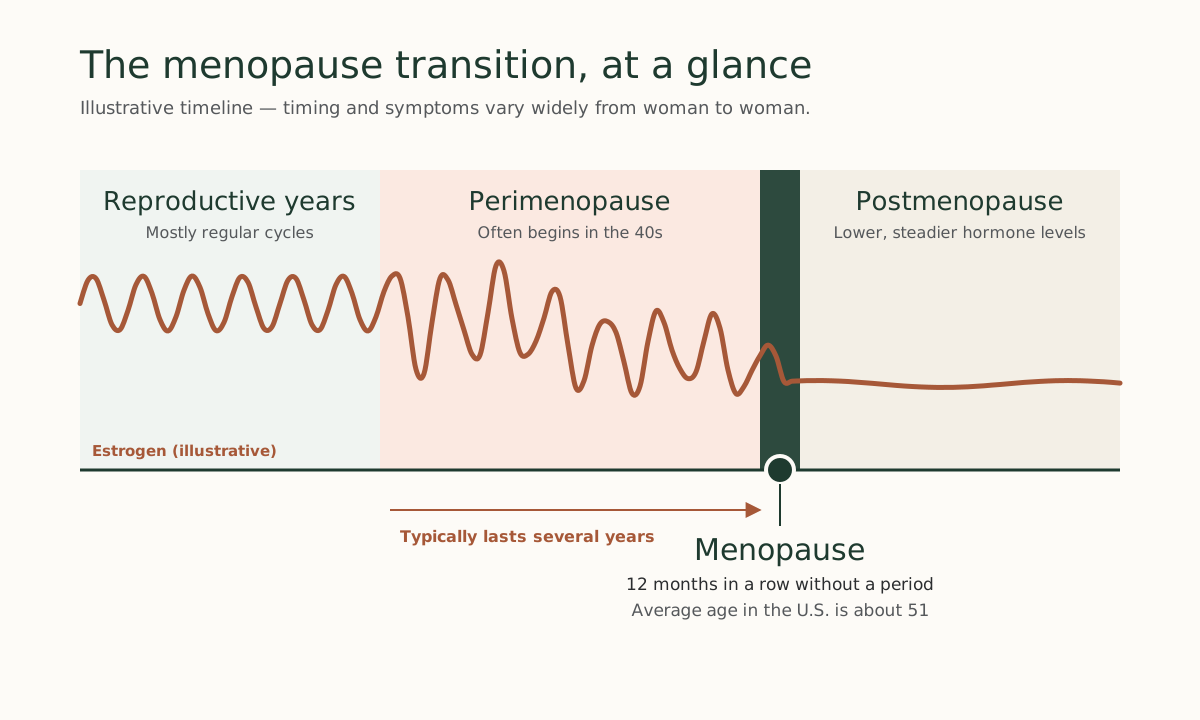
It typically lasts several years. Menopause itself is defined as 12 months in a row without a period. In the United States, the average age of menopause is about 51.
Perimenopause vs. menopause vs. postmenopause
| Stage | What it means | Periods |
|---|---|---|
| Perimenopause | The transition years; hormones fluctuate | Still happening, often irregular |
| Menopause | The point 12 months after your final period | Stopped |
| Postmenopause | All the years after menopause | Stopped; any bleeding should be checked by a doctor |
Common early signs
Every woman's experience is different, and you may have only one or two of these. Common changes include:
- Changes to your cycle. Periods may come closer together or further apart, be heavier or lighter, or skip months.
- Hot flashes and night sweats. Sudden waves of heat, flushing, or sweating—sometimes waking you at night.
- Sleep changes. Trouble falling or staying asleep, with or without night sweats.
- Mood shifts. More irritability, anxiety, or low mood than usual.
- Brain fog. Trouble with focus or word-finding.
- Vaginal dryness or discomfort during sex.
- Changes in libido, joint aches, and headaches.
Some of these overlap with other health issues, such as thyroid changes, anemia, or side effects of a medication. That's one more reason to mention them to your doctor rather than guessing.
You're not imagining it
These symptoms are common and real—and you don't have to simply "push through." Effective options exist, from lifestyle strategies to medical treatments.
Why do these changes happen?
Many perimenopause symptoms trace back to fluctuating, not simply falling, estrogen. Estrogen affects the brain's temperature control center, sleep, mood-related brain chemicals, and the tissues of the vagina and bladder. When levels rise and dip unpredictably, those systems can feel the ripple effects. Lower progesterone may also contribute to heavier periods and lighter sleep for some women.
How to track your symptoms
A simple log makes doctor's appointments far more productive. Each day (or whenever something changes), note:
- Your period: start and end dates, and how heavy it was
- Hot flashes or night sweats: how many, and any triggers you noticed
- Sleep: hours slept and how rested you felt
- Mood and energy: a quick 1–5 rating
- Anything else new: headaches, joint aches, brain fog, palpitations
After two or three months, patterns often become clear—to you and to your clinician.
Supportive lifestyle habits
Lifestyle changes can't stop the transition, but they can support how you feel through it.
Prioritize strength training
Estrogen helps protect bone and muscle. As it declines, resistance training two or more days a week supports bone density, muscle mass, and metabolic health. If you're new to strength training, our beginner's guide to strength training for women is a gentle place to start. Begin light and build slowly—and if you have osteoporosis, joint problems, or a heart condition, ask your doctor or a physical therapist which exercises are right for you.
Eat for bones and heart
Focus on protein at each meal, calcium and vitamin D sources, fiber-rich plants, and healthy fats. Heart disease risk rises after menopause, so this is a great time to build heart-friendly habits.
Protect your sleep
Keep your bedroom cool, wear breathable layers, limit alcohol and late caffeine, and keep a consistent sleep schedule. If you're waking in the night, our guide to perimenopause and 3 a.m. waking walks through gentle habits and when to ask for help.
Notice your triggers
Many women find that hot flashes are triggered by alcohol, spicy food, caffeine, hot drinks, or stress. Your symptom log can help you spot your own patterns. For more on what may help, see hot flashes and night sweats: what helps.
Care for your mood
Regular movement, time outdoors, connection with friends, and stress-reduction practices like slow breathing can all help. If low mood or anxiety lingers for more than a couple of weeks, please reach out to your doctor or a mental health professional—depression can become more likely during perimenopause, and it's very treatable.
If you're struggling right now
If you have thoughts of harming yourself, help is available 24/7. In the U.S., call or text 988 to reach the 988 Suicide & Crisis Lifeline. If you're in immediate danger, call 911.
Myths about perimenopause
"I'm too young for perimenopause." It often begins in the 40s, and for some women in the late 30s.
"If I still have periods, my symptoms can't be hormonal." Perimenopause happens while you still have periods—that's what makes it confusing.
"Hot flashes are the only real symptom." Sleep, mood, cycle, and cognitive changes are just as common and just as valid.
"There's nothing you can do." Lifestyle strategies, hormone therapy, and non-hormonal treatments can all help. A clinician can help you weigh your options.
Frequently asked questions
At what age does perimenopause usually start? It often begins in the 40s, and for some women in the late 30s. The average age of menopause in the United States is about 51, and perimenopause comes before it.
How long does perimenopause last? It typically lasts several years, but the length varies a lot from woman to woman. Menopause is reached after 12 months in a row without a period.
Can I still get pregnant during perimenopause? Yes. Ovulation becomes less predictable but can still happen, so ask your doctor about contraception if pregnancy isn't something you want.
Do I need a test to know if I'm in perimenopause? Often not. Clinicians usually rely on your age, symptoms, and cycle changes, so a symptom log is one of the most helpful things you can bring to an appointment.
Questions to ask your doctor
Bring your symptom log and consider asking:
- Could my symptoms be related to perimenopause, or something else (like thyroid changes, anemia, or a medication I take)?
- Which treatments—hormonal or non-hormonal—might be appropriate for me, and what are the benefits and risks?
- Do I still need contraception? (Pregnancy is still possible during perimenopause.)
- Should I have my bone health, cholesterol, or blood pressure checked?
- What symptoms should prompt me to come back sooner?
When to talk to your doctor
Talk to your healthcare provider if your symptoms are affecting your quality of life. Hormone therapy and non-hormonal treatments are available, and a clinician can help you weigh the benefits and risks for you.
Make an appointment promptly if you notice:
- Very heavy bleeding (soaking through a pad or tampon every hour for several hours in a row) or passing large clots
- Periods that last longer than seven days, or that come less than 21 days apart
- Bleeding between periods or after sex
- Any bleeding after you've gone 12 months without a period
- A racing or pounding heartbeat that's new for you
Get care right away (call 911) for chest pain or pressure, shortness of breath, fainting, or very heavy bleeding with dizziness. Don't assume these are "just perimenopause."
Perimenopause is a natural stage of life—but that doesn't mean you have to navigate it alone, or in discomfort.
Sources
We checked the information in this article against these sources:
- The Menopause Society. Patient Education
- ACOG. The Menopause Years (patient FAQ)
- ACOG. Perimenopausal Bleeding and Bleeding After Menopause (patient FAQ)
- U.S. Office on Women's Health. Menopause basics
- NIH National Institute on Aging. Hot Flashes: What Can I Do?
- 988 Suicide & Crisis Lifeline. 988lifeline.org
Last reviewed
Ready to put this into practice?
Free gift · no purchase needed
The Moonleaf Gift Box
Printable self-care pages + 4 phone wallpapers. See what's inside
One gentle email at a time. Unsubscribe whenever you like.
The Moonleaf Bundle – Vol. 1–3 — $27
food, movement & perimenopause
Get Vol. IThe Moonleaf Bundle – Vol. 4–6 — $27
stress, gut health & glowing skin
Get Vol. II
Keep reading
 Perimenopause
Hot Flashes and Night Sweats: What Actually Helps, According to the Evidence
What hot flashes are, simple comfort strategies, the non-drug approaches with the best research behind them, and how to talk to your doctor about treatment options.
 Perimenopause
 and Sleep: Why You're Waking at 3 a.m. and What Can Help
Why sleep often changes in perimenopause, gentle habits that support better rest, the insomnia approach doctors recommend first, and the warning signs worth checking.