Period Poops: Why Your Digestion Changes Around Your Period
Period poops are common: some women get constipated before a period and loose stools during it. Here is why it happens, what may help, and when to get checked.
For education, not medical advice. This article shares general wellness information and isn't a substitute for care from your doctor. Talk with a qualified healthcare provider before making changes to your diet, exercise, or supplements. Full disclaimer
In this article
- What are "period poops"?
- Why does your digestion change around your period?
- What may happen before your period
- What may happen during your period
- How to ease constipation before your period
- How to cope with loose stools during your period
- A simple way to spot your own pattern
- Common myths, gently corrected
- Frequently asked questions
- When to talk to your doctor
- Sources
- Further reading from trusted sources
In short
Period poops are common: some women get constipated before a period and loose stools during it. Here is why it happens, what may help, and when to get checked.
Your period is coming, and your belly seems to have its own opinions. Maybe you feel backed up for a few days, then suddenly everything runs the other way once the bleeding starts. Or you rush to the bathroom more often on day one.
Period poops are a real and very common thing. Changes in how often you go, and how loose or firm your stools are, can follow your cycle for many healthy women. This guide explains why, what may help, and which signs mean it is worth a call to your doctor.
What are "period poops"?
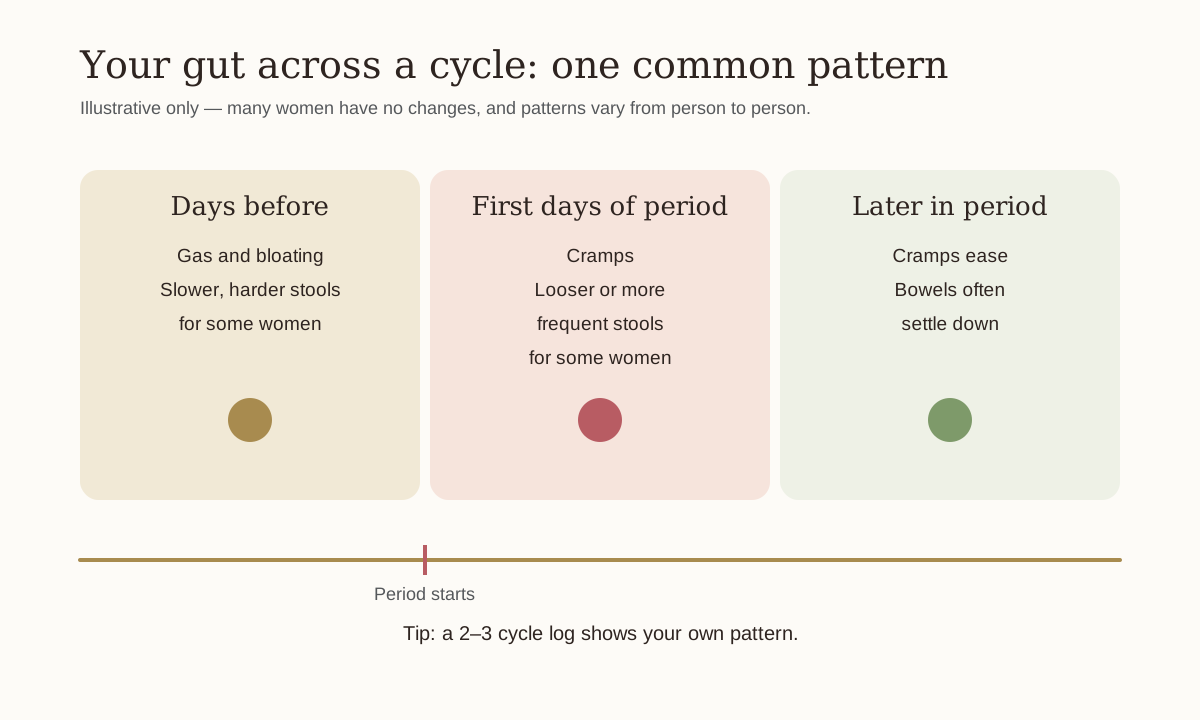
Period poops is a casual name for bowel changes around your menstrual cycle. They can mean looser or more frequent stools, constipation, gas, or cramping that comes with a bowel movement. Not everyone has them, and they do not follow one pattern.
In a survey of 156 healthy women published in BMC Women's Health, 73% reported at least one main digestive symptom (belly pain, diarrhea, constipation, nausea, or vomiting) either in the five days before their period or during it. So if this is happening to you, you are far from alone.
Digestive symptoms around the period
Percent of 156 healthy women reporting each symptom (survey of women attending a gynecology clinic)
Belly pain, 5 days before
Belly pain, during period
Diarrhea, during period
28%Diarrhea, 5 days before
24%
Source: Bernstein et al., BMC Women's Health, 2014 (PubMed 24450290)
Show as table
| Item | Value |
|---|---|
| Belly pain, 5 days before | 58% |
| Belly pain, during period | 55% |
| Diarrhea, during period | 28% |
| Diarrhea, 5 days before | 24% |
This was a small survey that relied on women remembering their symptoms, so treat the numbers as a snapshot rather than a rule. It does show how ordinary these changes are.
Why does your digestion change around your period?
Your digestion changes around your period most likely because the same hormones and body chemicals that run your cycle also reach your gut. Researchers think hormones, brain signals, and your gut communicate with each other, though the exact reasons are not fully settled.
Here are the main ideas.
- Prostaglandins. These are natural chemicals made in the lining of the uterus that make the uterine muscle contract, which causes cramps. The American College of Obstetricians and Gynecologists (ACOG) says their level is high on the first day of a period and drops as bleeding continues. ACOG also notes that painful periods can come with diarrhea and nausea. Researchers suspect these chemicals may affect the gut too, which could be why loose stools often show up early in a period.
- Shifting hormones. Estrogen and progesterone rise and fall across the month. The study above concluded that stomach and mood symptoms may share brain, gut, and hormone pathways.
- Stress and mood. In the same survey, women with symptoms such as anxiety or low mood were more likely to report two or more digestive symptoms. Our guide to stress and your menstrual cycle explains the link.
- Daily habits. Cravings, less sleep, more caffeine, and less movement before a period can all nudge your bowels in one direction or the other.
None of this means something is wrong with you. It means your gut is part of your cycle too.
What may happen before your period
In the days before a period, many women notice gas, a bloated belly, and sometimes slower or harder bowel movements. Constipation means having fewer than three bowel movements a week, or stools that are hard, dry, or lumpy, or hard to pass, according to the National Institute of Diabetes and Digestive and Kidney Diseases (NIDDK).
Our article on bloating before your period goes deeper on the puffy, gassy side. Here we focus on the bathroom side of things.
What may happen during your period
During the first days of a period, some women have softer, looser, or more frequent stools, sometimes with cramps. The NIDDK describes diarrhea as loose, watery stools three or more times a day, or more often than is normal for you.
For many women this settles by the middle or end of the period. Feeling a bit queasy or crampy along with it is common too.
How to ease constipation before your period
The NIDDK suggests getting enough fiber, drinking enough fluids, and adding fiber a little at a time so your body can adjust. It says most adults need roughly 22 to 34 grams of fiber a day, depending on age and sex.
Gentle ideas to try:
- Add fiber slowly. Oats, beans, lentils, berries, pears, chia, and vegetables are good options. Too much too fast can cause more gas. Our fiber and fermented foods guide has food-by-food numbers.
- Drink liquids through the day. Water, soups, and herbal tea all count. Fluids help fiber do its job.
- Move your body. ACOG says regular aerobic exercise, such as brisk walking, may lessen PMS symptoms. A 15-minute walk after a meal is an easy start.
- Keep a routine. Many people find a regular time after breakfast works best. Do not hold it when you feel the urge.
- Go easy on salty, ultra-processed foods. They tend to be low in fiber.
How to cope with loose stools during your period
When stools are loose, comfort and hydration come first. The NIDDK says the main goal with diarrhea is to replace lost fluids so you do not get dehydrated.
- Sip fluids regularly. Water, broth, or an oral rehydration drink all work.
- Eat simple foods if your stomach is unsettled, such as oatmeal, rice, bananas, or toast, and return to your usual food as you feel better.
- Notice triggers. Coffee, very spicy meals, and sugar alcohols (found in some sugar-free snacks) can loosen stools in some people.
- Use warmth. A heating pad on your lower belly may ease cramps.
- Check with your doctor before using medicines. If cramps are strong, ask your doctor which pain relief is right for you, since some pain relievers can upset a sensitive stomach.
A simple way to spot your own pattern
Because every body is different, a short log can tell you more than any general advice. For two or three cycles, write down a few things each day:
| What to track | Example |
|---|---|
| Day of your cycle | Day 24, or "3 days before period" |
| Bowel movements | How many, and hard, normal, or loose |
| Other symptoms | Gas, cramps, nausea, bloating |
| Food, caffeine, and fluids | Two coffees, little water |
| Sleep and stress | Slept 5 hours, tough week at work |
After a few cycles you may see that the changes show up at a predictable time. That can help you plan meals and downtime, and it gives your doctor useful information if you ever need to ask about it.
A real-life moment
Maya (a made-up example) noticed that every month, about three days before her period, she felt stuffed up and skipped her usual morning bathroom trip. On day one she was dashing to the bathroom. Once she began a simple log, she saw it happened every cycle. Adding oats and berries to breakfast and walking after lunch the week before her period did not make it vanish, but she felt calmer because she knew what to expect.
Common myths, gently corrected
"Period poops mean something is wrong." Usually they do not. Changes that come and go with your cycle are common in healthy women.
"You should cut out whole food groups to stop it." Cutting foods without guidance can leave you short on nutrients. If you suspect a food is a trigger, a doctor or registered dietitian can help you test it safely.
"Laxatives or anti-diarrhea pills are the answer every month." Medicines can have a place, but ask your doctor or pharmacist first, especially if you take other medicines or may be pregnant.
Frequently asked questions
Why do I poop more on my period? Many women have looser or more frequent stools in the first days of a period. ACOG notes that diarrhea can come with painful periods, and prostaglandins, the chemicals that cause cramps, are thought to play a role. Hormone shifts may add to it.
Is it normal to be constipated before my period? Yes, it is common. Some women notice slower digestion, gas, and bloating in the days before a period. Drinking enough fluids, adding fiber gradually, and moving daily may help.
Why do I get diarrhea and cramps at the same time? The uterus and bowel sit close together, and the chemicals that make the uterus contract may also affect the gut. It often eases after the first day or two. If the pain is severe, talk with your doctor.
Can IBS get worse around my period? The NIDDK says women with irritable bowel syndrome (IBS) often have more symptoms during their periods. IBS is a long-lasting digestive condition. If you suspect it, a doctor can sort it out.
Do period poops go away with age? Patterns change over time, especially around pregnancy and perimenopause, and some women notice different digestion at those stages. There is no single timeline.
When to talk to your doctor
Cycle-linked bowel changes are usually harmless. Please make an appointment if:
- Symptoms are new, getting worse, or do not follow your cycle
- Constipation or diarrhea does not improve with self-care, or you have diarrhea lasting more than two days
- Cramps or belly pain are severe, or get in the way of daily life
- You have very heavy bleeding (soaking a pad or tampon every hour for several hours in a row)
- You notice unexplained weight loss, or feel weak or very tired
- You have a family history of colon or rectal cancer
- You have painful periods plus pain with bowel movements or sex, which can be a sign of a condition like endometriosis
- Anxiety or low mood is making things harder. If you have thoughts of harming yourself, call or text 988 (U.S.). In immediate danger, call 911.
Get care right away (call 911 or go to an emergency room) for severe or constant belly pain, blood in your stool, black and tarry stools, repeated vomiting, a fever with belly pain, signs of dehydration such as dizziness or very little urine, or if you cannot pass gas. Tell a doctor if there is any chance you could be pregnant.
You know your body best. Noticing a pattern and asking about it is a sign of care, not worry.
Sources
We checked the information in this article against these sources:
- Bernstein MT et al. Gastrointestinal symptoms before and during menses in healthy women
- ACOG. Dysmenorrhea: Painful Periods
- ACOG. Premenstrual Syndrome (PMS)
- NIDDK. Symptoms & Causes of Constipation
- NIDDK. Eating, Diet, & Nutrition for Constipation
- NIDDK. Symptoms & Causes of Diarrhea
- NIDDK. Symptoms & Causes of Irritable Bowel Syndrome
Further reading from trusted sources
- National Institute of Diabetes and Digestive and Kidney Diseases (NIDDK): constipation, diarrhea, and irritable bowel syndrome
- American College of Obstetricians and Gynecologists (ACOG): painful periods and PMS
- BMC Women's Health: the 2014 survey on digestive symptoms around menstruation
Ready to put this into practice?
Free gift · no purchase needed
The Moonleaf Gift Box
Printable self-care pages + 4 phone wallpapers. See what's inside
One gentle email at a time. Unsubscribe whenever you like.
The Moonleaf Bundle – Vol. 1–3 — $27
food, movement & perimenopause
Get Vol. IThe Moonleaf Bundle – Vol. 4–6 — $27
stress, gut health & glowing skin
Get Vol. II
Keep reading
 Gut Health
Bloating Before Your Period: Why It Happens and What May Help
Why your belly can feel puffy in the days before your period, simple food and lifestyle habits that may ease it, and the bloating warning signs that should always be checked.
 Gut Health
Fiber, Fermented Foods & Your Gut: A Gentle Guide for Women
How fiber and fermented foods support your digestion, easy ways to add more plants to your week, what the research really shows, and the gut symptoms that need a doctor.