How to Calm Your Nervous System Quickly: 7 Gentle, Evidence-Based Ways
How to calm your nervous system quickly: 7 gentle, research-backed ways, from slow-exhale breathing to a short walk, plus honest limits and when to get support.
For education, not medical advice. This article shares general wellness information and isn't a substitute for care from your doctor. Talk with a qualified healthcare provider before making changes to your diet, exercise, or supplements. Full disclaimer
In this article
- What does it mean to calm your nervous system?
- Does breathing really calm you down?
- 7 gentle ways to calm your nervous system quickly
- A 5-minute reset you can use today
- What are the limits of these tools?
- Common myths, gently corrected
- Frequently asked questions
- When to talk to your doctor
- Sources
- Further reading from trusted sources
In short
How to calm your nervous system quickly: 7 gentle, research-backed ways, from slow-exhale breathing to a short walk, plus honest limits and when to get support.
Wondering how to calm your nervous system? Your heart is racing, your shoulders are up near your ears, and your mind is going in ten directions. You want to feel steady again, and you want it to happen fast.
The good news is that you can calm your nervous system quickly with a few simple tools, and you can try them in minutes. This guide shares seven gentle ones, what research does and doesn't say about them, and when it is time to ask for more support.
What does it mean to calm your nervous system?
To calm your nervous system means helping your body move out of its stress response and toward rest. The National Center for Complementary and Integrative Health (NCCIH) calls this the "relaxation response," the opposite of the stress response. Your heart and breathing can slow, and your muscles can soften.
Stress is a normal body reaction, not a flaw. These tools do not erase stress. They help you feel a little more settled so you can think clearly and decide what comes next. (For the bigger picture, see our guide to cortisol and gentle ways to unwind and how stress affects your menstrual cycle.)
Does breathing really calm you down?
Slow breathing may help some people feel less stressed, although the research is early. A 2023 analysis of 12 randomized trials with 785 adults found that breathwork was linked to lower self-reported stress than comparison activities. The authors also noted that most studies had a moderate risk of bias and urged caution.
How much breathwork helped in trials, on average
Effect size (g) compared with non-breathwork groups. Larger bars mean a bigger average benefit. Values shown without the minus sign.
Depressive symptoms (18 trials)
Stress (12 trials)
0.4 gAnxiety (20 trials)
Source: Fincham et al., Scientific Reports, 2023 (PubMed 36624160)
Show as table
| Item | Value |
|---|---|
| Depressive symptoms (18 trials) | 0.4 g |
| Stress (12 trials) | 0.4 g |
| Anxiety (20 trials) | 0.3 g |
The authors describe these results as small-to-medium effects. In plain words: breathing practices helped on average, but they are not a complete answer, and they work better as one tool among several.
7 gentle ways to calm your nervous system quickly
| Way | Time it takes | Good when |
|---|---|---|
| Slow breathing with a long exhale | 1–5 minutes | You feel keyed up or on edge |
| Progressive muscle relaxation | 5–10 minutes | Your body feels tense |
| Grounding with your senses | 1–2 minutes | Your thoughts are racing |
| A brisk or easy walk | 10+ minutes | You feel restless or stuck |
| Easing back on caffeine | Ongoing | You feel jittery |
| Reaching out to someone | A few minutes | You feel alone with it |
| A steady sleep routine | Ongoing | Stress keeps piling up |
1. Slow breathing with a long exhale
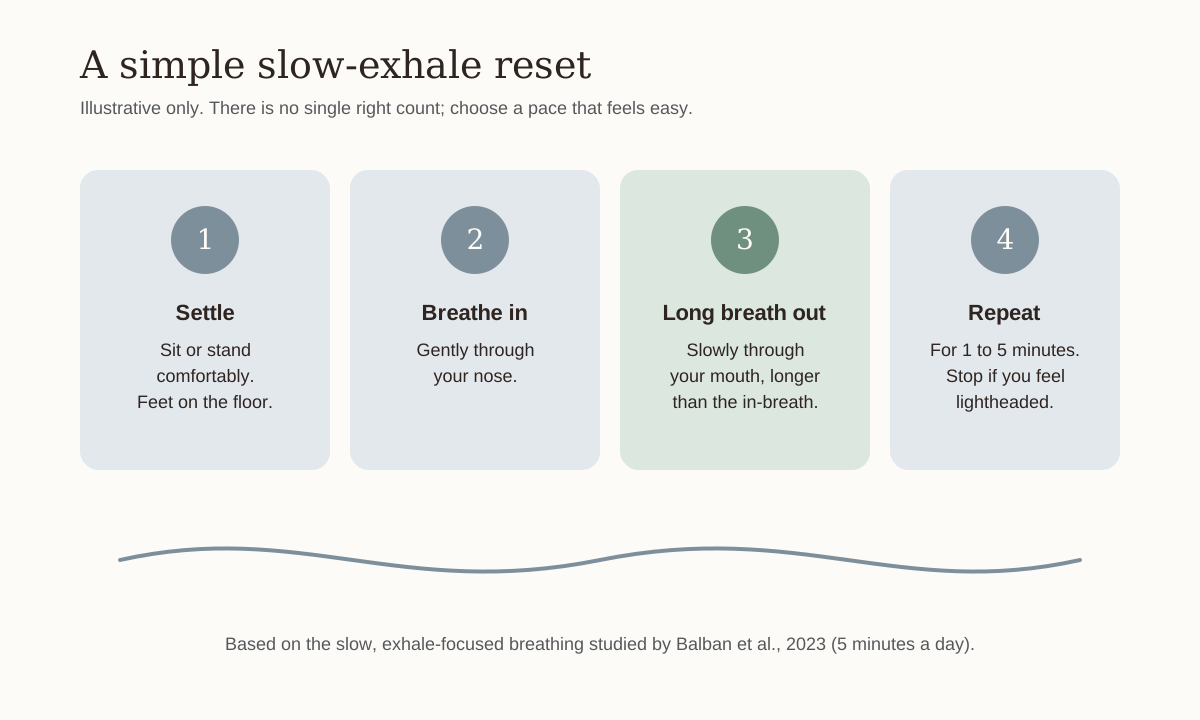
In a Stanford-led trial (Balban and colleagues, 2023), people who did five minutes a day of "cyclic sighing," a pattern that emphasizes long exhales, had greater improvement in mood and a larger drop in breathing rate over a month than people who did mindfulness meditation. It was one study, and the researchers called it promising rather than proven.
Try it: breathe in gently through your nose, then let a slow, longer breath out through your mouth. Repeat for one to five minutes. If you feel lightheaded, go back to normal breathing.
2. Progressive muscle relaxation
NCCIH describes progressive relaxation as tensing and then releasing muscle groups one at a time. Start with your feet and work upward, squeezing each area for a few seconds and then letting go. Many people find it easier than "just relax" because it gives your attention something to do.
3. Grounding with your senses
Grounding means bringing your attention to what is around you right now. A common version is to name five things you can see, four you can touch, three you can hear, two you can smell and one you can taste. There is little formal research on this exact exercise, so think of it as a free, low-risk way to interrupt a spinning mind, not a proven treatment.
4. A walk, even a short one
The National Institute of Mental Health (NIMH) lists exercise, along with regular healthy meals, among its tips for coping with stress. You do not need a workout. A walk around the block, some stretching, or a few minutes of gentle movement counts.
5. Easing back on caffeine
The NIMH suggests avoiding excess caffeine, such as soft drinks or coffee, when you are stressed. If you feel shaky or your heart is pounding after your second coffee, switching to water or herbal tea for the afternoon is a gentle experiment. If you take medicine or are pregnant, ask your doctor about caffeine for you.
6. Reaching out
The NIMH also encourages reaching out to friends or family who help you cope in a positive way. A short text or call can lower the feeling of carrying everything alone. You do not need to explain it perfectly. "I'm having a hard day" is enough.
7. A steady sleep routine
The NIMH recommends sticking to a sleep routine and getting enough sleep. Stress and poor sleep feed each other (if you wake in the early hours, see our guide to waking at 3 a.m. in perimenopause), so a regular bedtime, a dark room and a screen-free last half hour can make tomorrow's stress easier to handle.
A 5-minute reset you can use today
Here is one way to put it together when you feel overwhelmed:
- Minute 1: Put both feet on the floor and name where you are. Feel the chair under you.
- Minutes 2–4: Do slow breathing, with a long exhale each time.
- Minute 5: Relax your jaw, drop your shoulders, and pick one small next step.
Maya (a made-up example) used to scroll her phone in the car before walking into the house after a hard day. She tried this reset in the driveway instead. It did not remove the stress, but she noticed she greeted her family with a bit more patience.
What are the limits of these tools?
These techniques can help you feel calmer in the moment, but they are not treatments for anxiety disorders, depression, or trauma. NCCIH says relaxation techniques are generally safe for healthy people, but the evidence is mixed and, for several conditions, some of the research is low quality.
Go gently if you have a history of trauma or a mental health condition
NCCIH notes that people occasionally report negative experiences with relaxation techniques, such as more anxiety, intrusive thoughts or a fear of losing control. There are also rare reports of problems for people with epilepsy or certain psychiatric conditions, and possible concerns for people with a history of abuse or trauma. If this sounds like you, talk with your health care provider before trying breathing or relaxation practices, and stop if anything feels worse.
Common myths, gently corrected
"If a technique doesn't work right away, I'm doing it wrong." Skills like slow breathing usually feel easier with practice. Try different tools and keep the ones that suit you.
"Calming down means never feeling stress." Stress is a normal signal. The goal is to help your body settle afterward, not to avoid feeling anything.
"A supplement or special drink can reset my nervous system." We didn't cover supplements here. They can interact with medicines, so check with your doctor first.
Frequently asked questions
How can I calm my nervous system down fast? Slow your breathing with a longer exhale, relax your muscles from feet to shoulders, and step outside for a short walk. Studies suggest slow breathing may reduce stress, but effects are modest and vary from person to person.
How long does it take to calm your nervous system? It varies. Some people notice a difference within a few minutes, and studies have tested short daily sessions of about five minutes. If stress feels constant, longer-term habits like sleep and support matter more than any quick fix.
What are signs your nervous system is overwhelmed? Common signs include a racing heart, tight muscles, trouble sleeping, irritability and feeling on edge. If this stress interferes with daily life or does not go away, the NIMH says it may be time to talk to a professional.
Does deep breathing help anxiety? It may help some people feel calmer in the moment. A 2023 analysis found small-to-medium effects on anxiety symptoms, but it is not a substitute for treatment if anxiety is affecting your life.
Is it safe to try these if I'm pregnant or have a health condition? NCCIH says relaxation techniques are generally safe for healthy people, but occasionally cause more anxiety or intrusive thoughts, and there are rare reports of problems for people with epilepsy, certain psychiatric conditions or a history of abuse or trauma. If you are pregnant or have a heart, lung or other health condition, check with your doctor first.
When to talk to your doctor
Everyday stress is part of life. Please reach out to a doctor or mental health professional if:
- Stress or anxiety interferes with your work, relationships or daily activities
- You avoid things because of anxiety, or it feels like it is always there
- You are having panic attacks, or trouble sleeping most nights for weeks
- You feel hopeless, or you are using alcohol or other substances to cope
- Breathing or relaxation exercises make you feel worse
If you have thoughts of harming yourself, call or text 988 (U.S.). In immediate danger, call 911.
Get care right away (call 911 or go to an emergency room) for chest pain, trouble breathing that does not ease, fainting, or if you think you may be having a heart attack. A racing heart can feel like anxiety, but sudden chest pain needs to be checked.
You do not have to handle everything alone. Asking for support is a strong, practical step.
Sources
We checked the information in this article against these sources:
- Fincham GW et al. Effect of breathwork on stress and mental health: A meta-analysis of randomised-controlled trials
- Balban MY et al. Brief structured respiration practices enhance mood and reduce physiological arousal
- NCCIH. Relaxation Techniques: What You Need To Know
- NIMH. I'm So Stressed Out! Fact Sheet
Further reading from trusted sources
Ready to put this into practice?
Free gift · no purchase needed
The Moonleaf Gift Box
Printable self-care pages + 4 phone wallpapers. See what's inside
One gentle email at a time. Unsubscribe whenever you like.
The Moonleaf Bundle – Vol. 1–3 — $27
food, movement & perimenopause
Get Vol. IThe Moonleaf Bundle – Vol. 4–6 — $27
stress, gut health & glowing skin
Get Vol. II
Keep reading
 Stress
 and Your Menstrual Cycle: How Stress Can Affect Your Period
Why a stressful month can mean a late period or tougher PMS, what's happening in your body, gentle ways to support yourself, and when a missed period needs a doctor's visit.
 Stress
Cortisol, Explained: What Your Stress Hormone Really Does—and Gentle Ways to Unwind
What cortisol actually is, why it isn't the villain social media makes it out to be, the truth about 'adrenal fatigue,' and simple everyday ways to help your body feel calmer.