Perimenopause Weight Gain and Menopause Belly Fat: What Helps
Perimenopause weight gain and menopause belly fat are common. Why your body shifts, which gentle habits may help, and when to talk with your doctor.
For education, not medical advice. This article shares general wellness information and isn't a substitute for care from your doctor. Talk with a qualified healthcare provider before making changes to your diet, exercise, or supplements. Full disclaimer
In this article
- What is perimenopause weight gain?
- How much does body fat change during the menopause transition?
- Why do I get belly fat in menopause?
- What helps with perimenopause weight gain and menopause belly fat?
- A gentle sample week
- What are the common myths about menopause belly fat?
- Frequently asked questions
- When to talk to your doctor
- Sources
In short
Perimenopause weight gain and menopause belly fat are common. Why your body shifts, which gentle habits may help, and when to talk with your doctor.
Your jeans fit differently, even though you haven't changed how you eat. The scale creeps up, and the extra softness seems to settle around your middle. If this has started in your 40s, you're in very good company, and it isn't a failure of willpower.
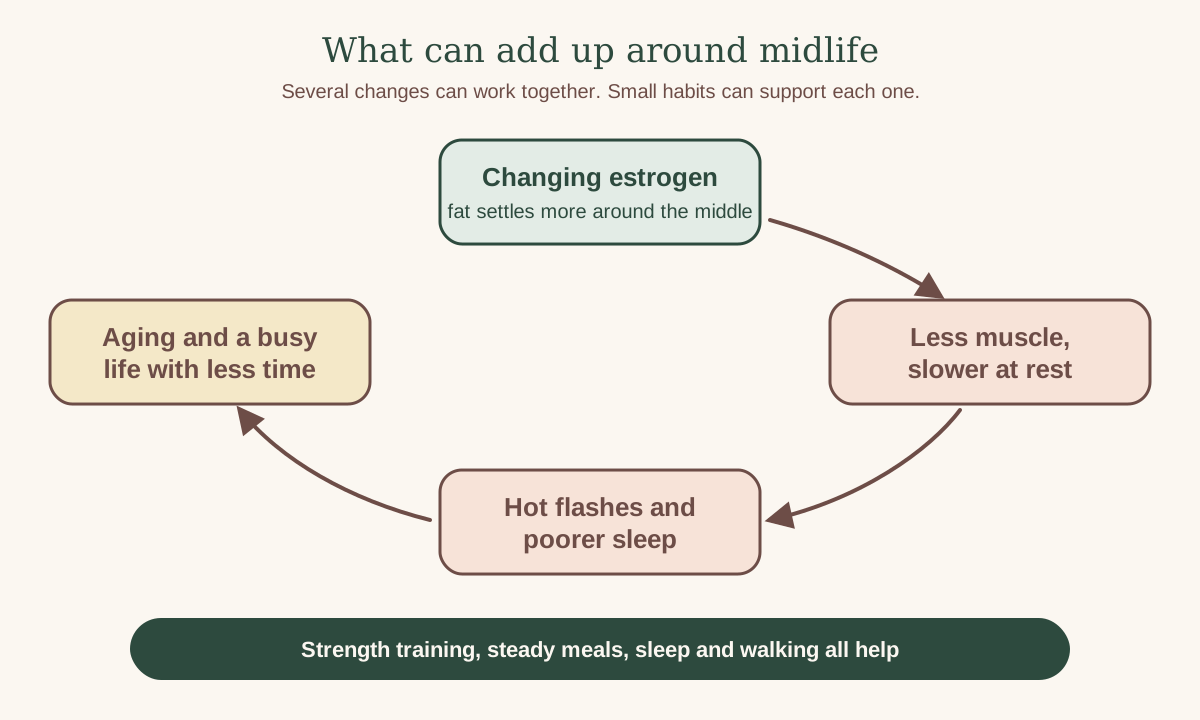
Perimenopause weight gain and menopause belly fat are common during midlife. Several changes can add up at once: shifting hormones, less muscle, poorer sleep and a busy life. The good news is that gentle, steady habits can support your body through this stage.
What is perimenopause weight gain?
Perimenopause weight gain is a gradual increase in body weight, often with more fat around the belly, during the years leading up to menopause. Perimenopause is the transition before your final period, when hormone levels, especially estrogen, rise and fall unevenly. Menopause is reached after 12 months without a period.
The Menopause Society describes midlife weight gain as having more than one cause, including aging. It also notes that falling estrogen can change where your body stores fat, with more of it going to the abdomen. That's why many women notice a change in shape even when the number on the scale barely moves.
How much does body fat change during the menopause transition?
In one large U.S. study, the pace of fat gain increased during the menopause transition, while lean mass (mostly muscle) dipped slightly. Researchers in the Study of Women's Health Across the Nation (SWAN) measured body composition with DXA scans and followed women across the transition.
In the average participant, fat mass rose about 1.0% per year before the transition and about 1.7% per year during it. Total weight did not jump at the transition, so the bigger change was in body composition: a little more fat and a little less muscle.
Yearly rise in body fat mass around menopause
Average change in fat mass, percent per year (SWAN study, DXA scans)
During the menopause transition
1.7%Before the transition
Source: Greendale et al., JCI Insight, 2019
Show as table
| Item | Value |
|---|---|
| During the menopause transition | 1.7% |
| Before the transition | 1% |
These are averages for a group of women, and every body is different. Think of them as an explanation, not a prediction for you.
Why do I get belly fat in menopause?
Belly fat in menopause is most often a mix of changing estrogen, less muscle, aging, and sleep and stress changes. No single cause explains it, which is also why no single trick fixes it.
| What's going on | How it can show up |
|---|---|
| Falling and uneven estrogen | Fat settles more around the middle than the hips and thighs |
| Less muscle mass | You burn a little less at rest, so the same meals can add up |
| Hot flashes and poor sleep | Tired days, more cravings, less energy to move |
| Stress and a full plate | Less time to cook, rest or exercise |
The Menopause Society's patient handout says that sleep problems and hot flashes may add to weight gain, and that having less muscle means burning fewer calories at rest. If sleep is your biggest struggle, our guide to perimenopause and 3am waking is a good place to begin.
What helps with perimenopause weight gain and menopause belly fat?
Nothing here is a quick fix, and none of it needs to be perfect. Think of it as a menu: pick one or two ideas, give them a few weeks, and keep what works for you.
Build and protect muscle
Muscle is the easiest lever you can pull. The CDC recommends that adults do muscle-strengthening activity at least 2 days a week. That can mean light weights, resistance bands, bodyweight moves or a beginner class. Our strength training guide for beginners has an at-home starter routine. If you have osteoporosis, joint problems or a heart condition, check with your doctor before starting.
Walk, and find movement you enjoy
The CDC also recommends 150 minutes of moderate-intensity activity a week, which can be spread out, such as about 30 minutes on 5 days. A brisk walk counts. If your periods are still happening, you can loosely match harder workouts to higher-energy days. Our cycle syncing 101 guide explains how, and it's fine to skip this part when your cycle is unpredictable.
Eat steady meals
Regular meals with protein, fiber-rich plants and healthy fats tend to keep energy and cravings steadier. A simple plate is half vegetables or fruit, a palm-sized portion of protein, and a fist of whole grains or beans. Our guide to blood-sugar-friendly meals shows how to build one. Crash diets and very low-calorie plans can cost you muscle and energy, so a gentle, flexible approach usually serves midlife better.
Protect your sleep
The CDC says adults need 7 or more hours of sleep. A steady wake-up time, a cool bedroom and less alcohol in the evening can all help. If night sweats are waking you, treating them may help your sleep and your energy for movement.
Make room for stress relief
A tired, stressed body often reaches for quick comfort food and skips the walk. Even five minutes of slow breathing or a short stroll helps. For ideas, see cortisol explained: gentle ways to unwind.
A note on hormone therapy and supplements
Hormone therapy is prescribed for menopause symptoms like hot flashes, and it isn't a weight-loss treatment. Whether it's right for you is a conversation for you and your doctor. Supplements marketed for "menopause belly fat" can interact with medications, and none has been shown to melt belly fat, so check with your doctor or pharmacist first. Never start, stop or change a medication based on an article.
A gentle sample week
A real-life moment: it's Tuesday, you're tired, and the walk feels like too much. Instead of skipping it, you do ten minutes around the block, then make a simple dinner of eggs, roasted vegetables and a slice of whole-grain toast. It isn't a perfect day, and it doesn't need to be.
| Day | One small step |
|---|---|
| Monday | 20-minute walk and a protein breakfast |
| Tuesday | 10 minutes of strength moves with light weights |
| Wednesday | Rest, early bedtime and a short wind-down |
| Thursday | 20-minute walk and a veggie-packed lunch |
| Friday | 10 to 15 minutes of strength moves |
| Weekend | One enjoyable activity: a hike, a dance class or gardening |
If a week falls apart, simply start again the next day.
What are the common myths about menopause belly fat?
"It's my fault. I'm just not trying hard enough." Hormones, muscle, sleep and aging all play a part, so this is not about willpower.
"I need to cut way back on food." Eating too little can cost you muscle and energy. Steady, nourishing meals work better for most women.
"Cardio alone will fix it." Walking and cardio are great for your heart and mood, but strength training protects the muscle that supports your metabolism.
"A supplement or special tea will melt belly fat." There's no good evidence for this, and some products can interact with medications.
"Nothing can be done." Weight changes are common, but small habits can support your energy, strength and health at any size.
Frequently asked questions
Is perimenopause weight gain normal? Yes, gradual weight gain is common during midlife. In the SWAN study, fat mass rose faster during the menopause transition, while total weight did not show a sudden jump. If your weight changes quickly or without explanation, talk with your doctor.
Why do I get belly fat in perimenopause and menopause? Falling estrogen can shift where your body stores fat toward the abdomen, and less muscle, aging, poorer sleep and stress can add to it. It's usually several things at once rather than one cause.
How can I reduce menopause belly fat? Strength training at least 2 days a week, regular walking, steady meals with protein and fiber, enough sleep and some stress relief can all help your body feel stronger. Where your body stores fat is partly hormonal, so focus on strength and energy, not a specific number.
Does hormone therapy help with menopause belly fat? Hormone therapy is prescribed for menopause symptoms such as hot flashes and night sweats, and it is not a weight-loss treatment. Ask your doctor whether it makes sense for you.
When to talk to your doctor
Weight changes are usually part of midlife, but see your healthcare provider if you notice:
- Fast or unexplained weight gain or loss, or sudden swelling in your belly, legs or ankles
- Extreme tiredness, feeling cold, constipation or dry skin, which can be signs of a thyroid problem
- Heavy or unusual bleeding, or any bleeding after 12 months without a period
- Increased thirst, frequent urination or blurry vision
- A history of disordered eating, or thoughts about food and your body that feel stressful or out of control. Support is available, and you don't have to cope alone
Bring a short note of what you've noticed and when. It makes the visit far more useful, and you can ask about blood pressure, blood sugar and cholesterol checks, since midlife weight changes can affect them.
Get care right away (call 911) for chest pain or pressure, severe shortness of breath, fainting, or sudden weakness on one side of the body.
Your body is changing, not failing. Start with one small step, and if you'd like gentle support, get the free Moonleaf Gift Box: printable self-care pages and phone wallpapers to help you build calm, steady habits.
Sources
We checked the information in this article against these sources:
- Greendale GA, et al. Journal of Clinical Investigation Insight. Changes in body composition and weight during the menopause transition
- The Menopause Society. MenoNote: Weight Gain
- CDC. Adult Activity: An Overview
- CDC. About Sleep
Ready to put this into practice?
Free gift · no purchase needed
The Moonleaf Gift Box
Printable self-care pages + 4 phone wallpapers. See what's inside
One gentle email at a time. Unsubscribe whenever you like.
The Moonleaf Bundle – Vol. 1–3 — $27
food, movement & perimenopause
Get Vol. IThe Moonleaf Bundle – Vol. 4–6 — $27
stress, gut health & glowing skin
Get Vol. II
Keep reading
 Perimenopause
 Brain Fog: Causes and What Helps
Perimenopause brain fog is common: forgetfulness and trouble focusing can come with changing hormones, poor sleep and stress. What helps, and when to get checked.
 Perimenopause
Natural Remedies for Hot Flashes at Night
Natural remedies for hot flashes at night: a cooler bedroom, layers, slow breathing and triggers to notice, plus CBT, hypnosis and when to ask your doctor.