Perimenopause Brain Fog: Causes and What Helps
Perimenopause brain fog is common: forgetfulness and trouble focusing can come with changing hormones, poor sleep and stress. What helps, and when to get checked.
For education, not medical advice. This article shares general wellness information and isn't a substitute for care from your doctor. Talk with a qualified healthcare provider before making changes to your diet, exercise, or supplements. Full disclaimer

In short
Perimenopause brain fog is common: forgetfulness and trouble focusing can come with changing hormones, poor sleep and stress. What helps, and when to get checked.
You walk into a room and forget why. A word you've used a thousand times sits just out of reach. You reread the same email three times before it sinks in. If this has started in your 40s, you're not imagining it, and you're not losing your mind.
Perimenopause brain fog is the everyday forgetfulness, distraction and trouble concentrating that many women notice during the menopause transition. It's common, it's usually subtle, and there are practical things that can help.
What is perimenopause brain fog?
Brain fog isn't a medical diagnosis. It's a handy name for a group of changes in thinking that the Menopause Society describes as difficulty remembering words, names, anecdotes and numbers, trouble focusing and concentrating, and being easily distracted.
The Menopause Society says that forty to sixty percent of midlife women report cognitive symptoms such as forgetfulness during the menopause transition, and calls brain fog during perimenopause "very common." Memory and concentration complaints can also continue in the years right after menopause.
Midlife women reporting forgetfulness or similar symptoms
Reported range during the menopause transition, percent
Up to 60%
60%At least 40%
Source: The Menopause Society, Perimenopause patient education
Show as table
| Item | Value |
|---|---|
| Up to 60% | 60% |
| At least 40% | 40% |
Why does perimenopause cause brain fog?
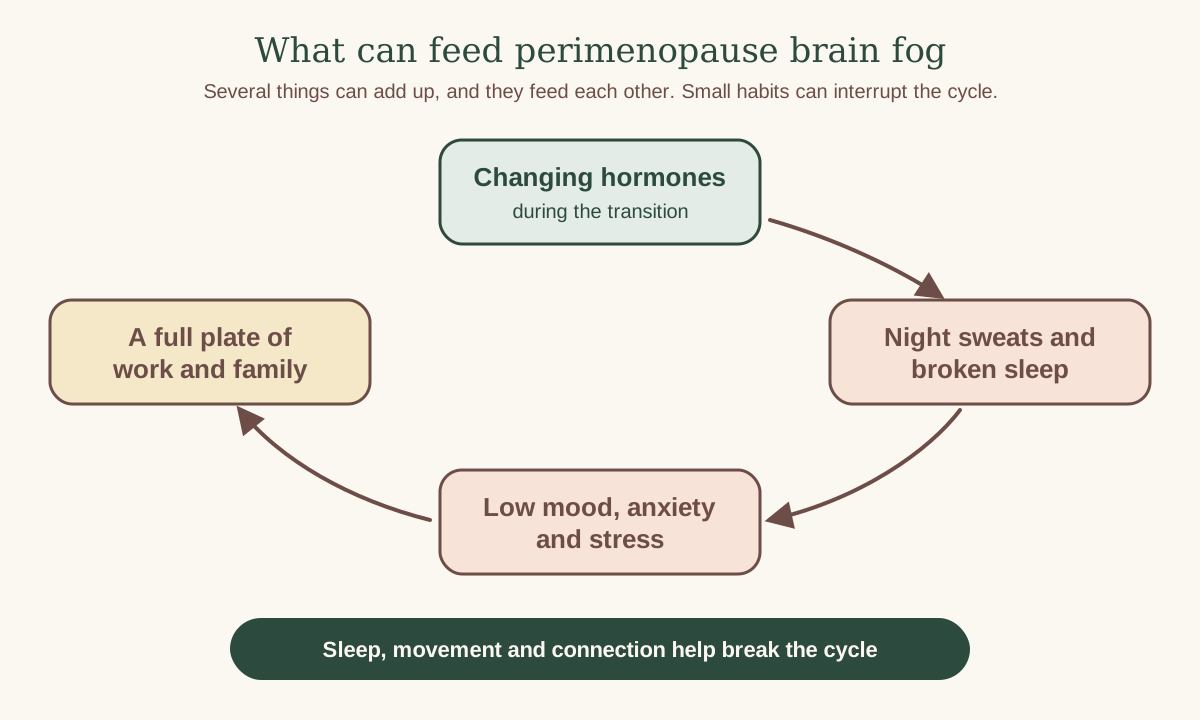
Researchers don't have every answer yet. The Menopause Society notes that thinking skills at midlife appear to be influenced by the stage of the menopause transition, as well as by symptoms like sleep difficulties and mood changes. In plain words: changing hormones may play a part, and so can the poor sleep, low mood and stress that often travel with them.
Here's how those pieces can add up:
| What's going on | How it can feel |
|---|---|
| Changing hormones during the transition | Words and names harder to find |
| Night sweats and broken sleep | Foggy, slow, or easily distracted the next day |
| Low mood or anxiety | Trouble concentrating or making decisions |
| A full plate of work, family and worry | Mental overload and forgetting small things |
It can be a vicious circle. A restless night makes it harder to concentrate, the day feels stressful, and the next night is lighter again. That's why the habits below often start with sleep. If sleep is your biggest struggle, our guide to perimenopause and 3am waking is a good place to begin.
Is perimenopause brain fog normal, or is it dementia?
For most women, it's the first. Many women worry that forgetfulness means dementia. The Menopause Society says that is rarely the case, because the changes that typically happen around midlife are more subtle, and an Alzheimer disease diagnosis is very rare before age 60.
Still, you know your own mind best. If changes feel obvious or are getting in the way of daily life, the Menopause Society advises bringing them to a healthcare professional, who can look for causes that can be treated.
What helps with perimenopause brain fog?
Nothing here is a quick fix, but several habits are supported by The Menopause Society as ways to benefit memory and overall brain health. Think of them as a menu: choose one or two and build from there.
Protect your sleep first
Most adults need 7 or more hours of sleep a night, according to the CDC. Keep a steady wake-up time, make your bedroom cool and dark, and go easy on caffeine late in the day and alcohol in the evening. If night sweats are waking you, our article on hot flashes and night sweats covers what may help.
Keep moving, and keep your mind busy
The Menopause Society lists staying physically and mentally active among the lifestyle measures that may benefit memory. That can be as simple as a daily walk, a strength session, a crossword, learning a few words of a new language, or picking up a hobby that's new to you.
Stay connected
Social connection is on the same list. A weekly coffee with a friend, a walking group, or a phone call counts. It also tends to lift mood, which matters for concentration.
Eat in a Mediterranean style
The Menopause Society mentions a Mediterranean-style diet and omega-3 fats as part of a brain-friendly pattern. In practice that means plenty of vegetables, fruit, beans, whole grains, nuts, olive oil, and fish. It doesn't have to be perfect.
Look after your heart numbers
Managing blood pressure, blood sugar and cholesterol, not smoking, and drinking alcohol in moderation also make the Menopause Society's list. A yearly check-up with your doctor is a good moment to review them.
What about hormone therapy and supplements?
The Menopause Society says hormone therapy is not recommended to improve thinking or memory in natural menopause. It can still be an option for other symptoms, so please talk with your doctor about what fits you. Supplements marketed for "brain support" can interact with medications, so check with your doctor or pharmacist first. Never start, stop or change a medication based on an article.
Everyday tricks for foggy days
Alongside the big habits, small systems take the pressure off your memory:
- Write it down. Keep one notebook or one phone list for to-dos, so you don't hold it all in your head.
- Give things a home. Keys, glasses and your phone always go in the same spot.
- Do one thing at a time. Multitasking makes forgetting more likely, and a fog makes it worse.
- Do hard thinking when you're sharpest. Many women have a better time of day. Save demanding tasks for it.
- Set reminders for appointments, medications and bills.
- Be kind to yourself. Forgetting a word doesn't say anything bad about you.
A real-life moment: you're in a meeting and the name of a colleague vanishes. Instead of panicking, you say "give me a second" and glance at your notes. A minute later the name comes back. A small system and a calm response can turn a stressful slip into a non-event.
Myths, gently corrected
"Brain fog means I'm getting dementia." Usually not. Changes around midlife are typically subtle, and Alzheimer disease is very rare before age 60, according to the Menopause Society.
"I just need to try harder." Pushing harder on a tired brain rarely works. Better sleep, movement and fewer demands often help more.
"There's a pill for it." There's no single pill. Hormone therapy isn't recommended for brain fog in natural menopause, so habits and a check-up for other causes are the main tools.
"It's all in my head." Brain fog is common, well recognized, and very real.
Frequently asked questions
Is brain fog a symptom of perimenopause? Yes. The Menopause Society calls brain fog during perimenopause very common, and says forty to sixty percent of midlife women report forgetfulness or similar cognitive symptoms during the menopause transition.
How long does perimenopause brain fog last? It varies from woman to woman. Memory and concentration complaints are common during the transition and in the years just after menopause. If it's getting worse or getting in the way of daily life, ask your healthcare provider.
Can poor sleep cause brain fog in perimenopause? It can contribute. The Menopause Society notes that sleep difficulties and mood changes appear to influence thinking at midlife, so improving sleep is a sensible first step. Our guide to the early signs of perimenopause shows how sleep fits into the wider picture.
What helps perimenopause brain fog naturally? Regular physical and mental activity, social connection, steady sleep, a Mediterranean-style way of eating, and keeping blood pressure, blood sugar and cholesterol in check may all benefit memory. They won't switch brain fog off overnight, but they support your brain and your mood.
When to talk to your doctor
Brain fog is usually nothing to fear, but it's worth a conversation if:
- Memory or thinking changes feel obvious, are getting worse, or are affecting work, driving, or daily tasks
- Someone close to you has noticed a change that worries them
- You also have heavy or unusual periods, fatigue, or other symptoms. Thyroid changes, anemia and some medications can also affect focus, and a doctor can check
- You've felt hopeless, lost interest in things, or struggled to concentrate or make decisions most of the day, nearly every day, for at least two weeks. These can be signs of depression, which is common and treatable
Bring a short note of what you've noticed and when. It makes the visit far more useful.
If you're struggling right now
If you have thoughts of harming yourself, help is available 24/7. In the U.S., call or text 988 to reach the 988 Suicide & Crisis Lifeline. If you're in immediate danger, call 911.
Get care right away (call 911) for sudden confusion, trouble speaking, face drooping, weakness on one side of the body, a sudden severe headache, or fainting. Don't assume these are brain fog.
Perimenopause brain fog can be frustrating, but for most women it's a normal, manageable part of the transition. You're not alone, and small steps really do add up.
Sources
We checked the information in this article against these sources:
- The Menopause Society. Perimenopause
- The Menopause Society. Mental Health
- CDC. About Sleep
- 988 Suicide & Crisis Lifeline. 988lifeline.org
Ready to put this into practice?
Free gift · no purchase needed
The Moonleaf Gift Box
Printable self-care pages + 4 phone wallpapers. See what's inside
One gentle email at a time. Unsubscribe whenever you like.
The Moonleaf Bundle – Vol. 1–3 — $27
food, movement & perimenopause
Get Vol. IThe Moonleaf Bundle – Vol. 4–6 — $27
stress, gut health & glowing skin
Get Vol. II
Keep reading
 Perimenopause
Hot Flashes at Night Remedies: What Helps
Hot flashes at night remedies backed by evidence: a cooler bedroom, CBT and hypnosis, plus what night sweats mean and when to ask your doctor about treatment.
 Perimenopause
Why Do I Wake Up at 3am Every Night? Sleep Tips
Why do I wake up at 3am every night? In perimenopause, night sweats, hormones and stress can play a part. Perimenopause sleep tips that help, and when to ask.